Column · @downspoutsjournal760
Managing Gutter Drainage to Protect Landscaping in Astor, Florida
A good gutter system does more than keep water off the porch. In a place like Astor, where heavy rain can arrive fast and leave just as quickly, gutter drainage often decides whether your landscaping stays intact or gets carved up by runoff. I have seen beautiful beds washed out by a single downspout that emptied in the wrong place. I have also seen modest yards stay neat and healthy simply because the roof water had somewhere sensible to go.
That is the real job of gutter drainage in Florida. It is not only about the roofline. It is about what happens after the water leaves the gutter. If that water lands beside the foundation, it can pool. If it shoots into a mulch bed, it can trench through the soil. If it empties near a walkway or outdoor living area, it can create a muddy mess that lingers well after the storm.
Florida-Friendly Landscaping guidance has long emphasized keeping runoff on site when possible and directing downspouts into areas that can absorb water, such as turf, planting beds, rain gardens, rain barrels, cisterns, or other pervious spaces. That basic idea matters a lot in Astor yards. Sandy soil can absorb water, but intense roof runoff can still move faster than the landscape can handle if everything is concentrated in one spot.
What roof runoff actually does to a Florida yard
Most homeowners notice the dramatic damage first. Mulch floats away. A low area stays wet. Soil splashes up onto siding. The lawn thins out where water repeatedly pounds the same strip of ground. Those are the visible clues, but the more important issue is concentration. Rain falling across the whole yard is one thing. Rain coming off a roof plane and dumping through a single downspout is another.
A surprisingly small roof section can send a lot of water into one corner of the lot during a summer storm. When that flow has no plan, it tends to make its own path. In planting beds, that often means erosion around roots, exposed landscape fabric, displaced pine bark or rock, and muddy runoff staining hard surfaces. Near the house, poor drainage can leave water standing where you do not want it, and UF/IFAS guidance notes that pooling near the foundation can also contribute to pest issues.
This is why homeowners sometimes misread the problem. They think they need more mulch, more plants, or more edging. Sometimes those things help, but the real fix is upstream. The drainage path has to change.
The first question to ask is simple: where does each downspout end?
When I look at a house with landscape washout, I do not start with the plants. I start by walking the perimeter during dry weather and tracing every downspout. Some terminate onto turf and behave fine. Some end in a bed that can absorb the flow without trouble. Others are clearly overloaded, especially where roof runoff from a large section gets dumped into a narrow strip between the house and a walkway, lanai, or driveway.
Astor properties often have outdoor areas that matter just as much as the front planting bed. If the runoff spills near a patio edge, side yard gate, or pool area, it can make those spaces unpleasant to use. For homes with screened enclosures, gutter drainage for pool cages deserves extra attention. The cage itself changes how water moves around the outdoor area, and homeowners usually want to avoid splashback, muddy corners, and overflow around the deck perimeter. Roof drainage in those spaces should be controlled deliberately, not left to guesswork.
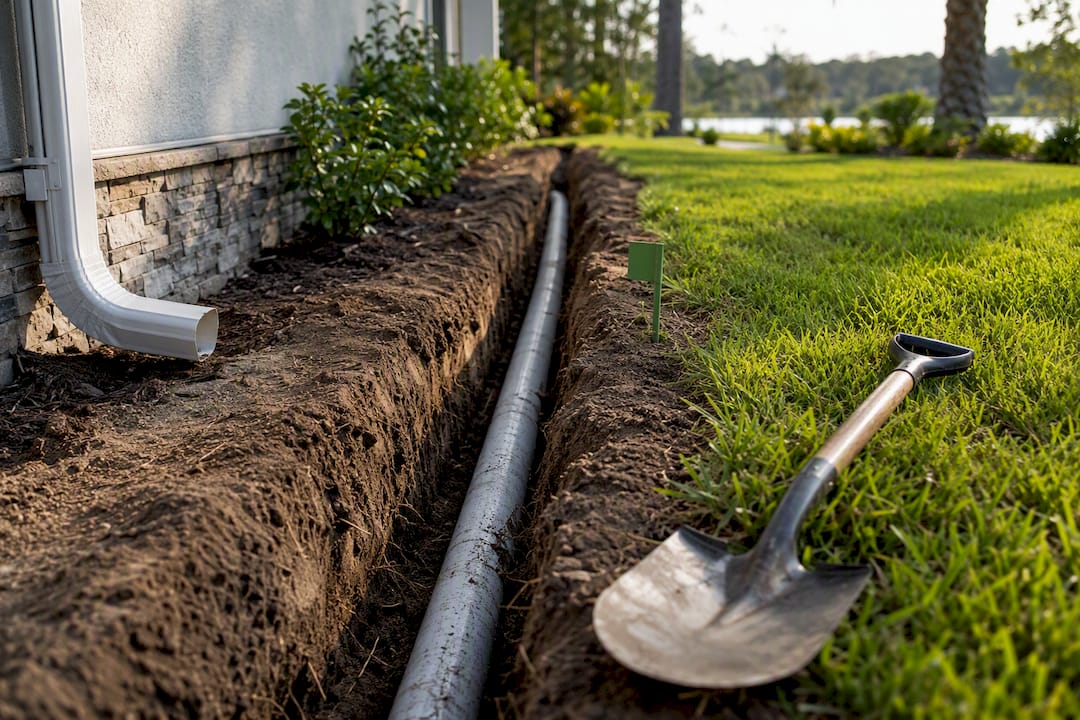
A downspout does not need to move water far to make a big difference. Sometimes the right change is simply redirecting the discharge away from the foundation and into a section of lawn or planted area that can absorb it. That lines up with Florida guidance on reducing runoff and keeping water on site where practical.
Why landscaping suffers even when the gutters seem to work
A lot of people hear the word “gutter” and think only of clogs, leaks, or sagging sections. Those matter, but a system can be technically functional and still be hard on the yard. Water may travel through the gutter properly, exit the downspout correctly, and still land in the worst possible place.
This is one of the most common gutter myths Florida homeowners run into. They assume that if water is no longer pouring over the gutter edge, the system is doing its job. Not necessarily. From a landscaping standpoint, the system works only if runoff leaves the roof and enters an area that can handle it without erosion, pooling, or repeated washout.
That distinction changes how you evaluate repairs and upgrades. A gutter adjustment is not always about the gutter body itself. It may involve the outlet location, the downspout extension, or the way the discharge is spread into the yard. The landscaping and the drainage have to be treated as one system.
Signs your drainage is stressing the landscape
You do not need a major failure to know there is a problem. Usually the yard tells you in smaller ways first.
- Mulch shifts or disappears after storms.
- Soil is exposed beneath shrubs or along bed edges.
- Water stands near the house after rain.
- Lawn areas below downspouts stay muddy or thin out.
- Splash marks appear on walls, screens, or hardscape.
Those signs often show up before homeowners think to call for gutter repair Hawthorne FL, gutter cleaning Dunnellon FL, or a similar service in their own area. The town name changes, but the pattern is the same across much of Florida. Maintenance issues at the roof edge become yard issues at ground level.
The best landing zones for downspouts in Florida yards
Florida-Friendly guidance gives a useful framework here. The goal is usually to direct roof runoff into places that can absorb it rather than sending it toward the street or letting it collect beside the home. Turf can work. Planting beds can work. Rain gardens, rain barrels, and cisterns may also make sense, depending on the property and how much maintenance the homeowner wants to take on.
What matters most is not the label, but the performance. A planting bed is only a good receiving area if it is sized and shaped to handle recurring runoff. If the bed is narrow, heavily mulched, and edged by a hard barrier that traps water, it may wash out every time. A lawn area may be a better receiver simply because it spreads the flow and gives the water room to soak in.
In sandy soils, people sometimes assume every part of the lot drains equally well. That is rarely true in practice. Slight grade changes, compacted areas near walkways, and root zones can all affect how water behaves. I have seen one downspout section of a yard dry out quickly while another section, only twenty feet away, stayed boggy after every storm. Watching where the water actually goes is more useful than relying on assumptions about the soil alone.
Planting bed damage is often a design mismatch
When downspouts empty into beds, the bed itself has to be built for that role. A decorative bed meant mainly for curb appeal is not automatically a drainage bed. If it has shallow mulch, fine soil, and small ornamental plants close to the discharge point, runoff can beat it up quickly.
This does not mean downspouts should never empty into planted areas. UF/IFAS guidance specifically includes planting beds among acceptable places to direct runoff when they can absorb it. The point is that the bed must be able to receive concentrated roof water without unraveling. Often that means giving the runoff a wider landing area, avoiding delicate plant placement right at the outlet, and making sure the flow does not immediately exit the bed and cut through the adjacent lawn.
On homes with foundation plantings, another common mistake is sending water into the bed but too close to the house. That may keep the runoff out of the middle of the yard, but it is still not ideal if water lingers near the structure. Roof water should move away from the house and into an area that can absorb it.
When pool areas and screened enclosures complicate everything
Pool-adjacent drainage problems are their own category. A backyard with a cage, deck, and surrounding hardscape has fewer forgiving surfaces than an open lawn. There is less room for error. Water that would disappear into turf in another part of the yard may instead run across a deck edge, collect in corners, or carry debris where no one wants it.
That is why gutter drainage for pool cages deserves a separate look during any drainage review. The aim is not just to stop erosion, but also to preserve the usability of the space. Overflow near entrances, muddy strips outside the enclosure, or repeated splash against screening can all be signs that roof runoff needs a better path.
This is one case where “good enough” usually is not. Outdoor living areas reveal drainage flaws quickly because people are in them often. If the same corner of the deck or cage perimeter gets hit every storm, homeowners notice.
https://runoffguide074.evercolumn.com/posts/k-style-gutters-in-lady-lake-fl-how-their-shape-handles-fast-roof-runoffRoutine maintenance matters more than people think
Even the best drainage plan falls apart if the gutter system fills with debris. UF/IFAS notes that gutters and downspouts require maintenance because leaf litter and other buildup can contribute to drainage problems. Once debris slows flow, water may overshoot outlets, spill at seams, or pour over a clogged edge directly into beds that were never supposed to receive that much water.
This is where the question of DIY gutter cleaning or hire a pro becomes practical rather than philosophical. Some homeowners are comfortable cleaning lower, accessible sections and checking basic flow after a storm. Others have rooflines, heights, or conditions that make that a poor trade. The choice depends on access, safety, and how well the homeowner can spot developing issues like loose sections, poor drainage at one outlet, or water backing up in a corner.
A lot of landscape damage starts with a maintenance problem that went unnoticed for a season or two. The plants get blamed first because the failure shows up at ground level. Meanwhile the real cause has been sitting at the eave the whole time.
Gutter guards can help, but they are not a free pass
Homeowners often ask about protection products after one bad cleanup or one expensive bed repair. Gutter guards Mount Dora FL is a phrase plenty of people search, and the interest makes sense. Debris control can reduce how quickly material builds up in the system. Still, guards are not a license to forget the gutters exist.
In Florida conditions, anything exposed to leaves, needles, and storm debris will still need periodic inspection. Guards may reduce cleaning frequency, but they do not eliminate the need to verify that water is entering the system properly and exiting where you want it. From a landscaping perspective, the only result that matters is whether runoff is still being controlled.
I have seen protected systems that stayed cleaner but still discharged poorly because the downspout location was wrong from the start. Product upgrades help only when they support a sensible drainage plan.
Material and roof type affect drainage behavior
Not all roof edges shed water the same way, and not every gutter setup suits every roof. Homeowners researching gutters for metal roofs Florida often learn quickly that runoff can move briskly off certain roof surfaces. That can put more pressure on the receiving gutter and the discharge point below, especially in hard rain.
The exact design choices depend on the home, but the lesson for landscaping is straightforward. Faster collection and concentrated discharge mean the area below the downspout has to be chosen carefully. If your yard already shows signs of washout, changing the gutter profile alone may not solve the issue unless the drainage landing zone is addressed too.
Seamless gutters Williston FL is another search phrase homeowners see often, and the appeal is understandable because fewer joints can mean fewer leak points. From a yard protection standpoint, fewer drips and leaks along the run can help keep isolated bed sections from getting unexpectedly soaked. Still, the seamless part is only one piece. Where the water goes after the downspout remains the more important landscaping question.
Cost decisions should be tied to the landscape problem you are trying to solve
When people compare gutter installation cost factors Florida, they usually focus on size, material, home layout, and labor access. Those are real variables, but there is another cost question that deserves equal weight: how much damage is the current drainage causing below?
A homeowner with minor cosmetic overflow may prioritize basic functionality. A homeowner replacing mulch three times a year, dealing with standing water beside the house, or watching a poolside bed erode after every storm has a stronger reason to invest in better drainage planning during installation. The smartest spending is often the spending that prevents repeat repairs to the landscape.
That is why I like to tie every gutter recommendation back to the ground. If you are paying for new gutters, repairs, or modifications, they should solve the runoff pattern, not just improve the roofline appearance.
Appearance still matters, especially in neighborhoods with review standards
Gutters are functional, but they are also visible. Homeowners care about how they blend with soffit, fascia, roof color, and trim. Searches for gutter colors for Florida homes are common for a reason. The right color can make the system disappear. The wrong one can draw attention to every downspout.
For homeowners in neighborhoods with an HOA or architectural review process, color and exterior appearance may need approval. Florida law gives associations authority over exterior appearance standards, including color and style requirements related to exterior products, though those standards still have to comply with building code and cannot be used to deny conforming installations. In practice, that means it is worth checking appearance rules before ordering visible components.
That said, landscaping protection should not be sacrificed for aesthetics. A cleaner-looking downspout location is not better if it dumps water into the one bed that washes out every month. The best result usually balances both, proper function first, tidy appearance second.
A practical way to evaluate your own property
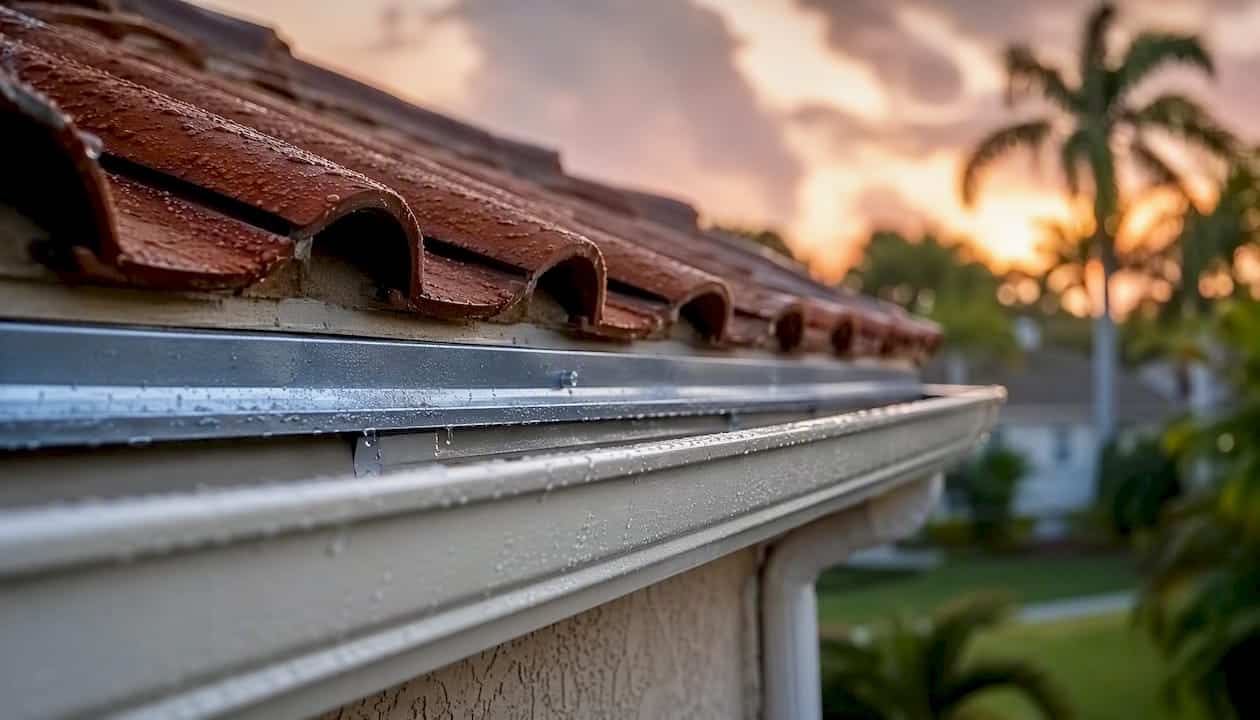
The easiest time to diagnose gutter drainage is during or just after a hard rain. You do not need to overcomplicate it. Watch where water exits, where it lands, and whether it stays put or starts moving soil and mulch. If you cannot be outside during the storm, inspect the discharge areas once the rain stops. Fresh channels, displaced mulch, and muddy splash marks tell the story.
If you want a simple review routine, this works well:
- Check each downspout outlet after a storm.
- Look for pooling near the house or outdoor living areas.
- Inspect beds for mulch displacement and exposed roots.
- Clear debris before the rainy season gets busy.
- Recheck flow after any gutter repair or installation.
That basic habit doubles as a year-round gutter checklist Florida homeowners can actually stick with. It is short enough to do and specific enough to catch problems early.
When a small correction is enough, and when it is not
Not every drainage issue requires a full replacement. Sometimes the cure is straightforward: cleaning debris, repairing a problem section, or redirecting a downspout to a better receiving area. If one bed is repeatedly getting hammered while the rest of the system performs well, a targeted correction may solve the whole problem.
Other times, the symptoms show a larger mismatch between the roof drainage and the property layout. If multiple corners overflow, if runoff repeatedly ends up near the foundation, or if poolside and landscape areas both suffer after storms, the system likely needs a more coordinated rethink. That is where homeowners often benefit from stepping back and evaluating the full path from roof edge to final discharge area.
The key is not to chase cosmetic damage over and over. If mulch replacement has become routine, the landscape is telling you something. Water always wins when the drainage path is wrong.
The real goal is a quieter yard after rain
The best gutter drainage setup usually goes unnoticed. After a storm, the beds still look neat. The lawn is wet but not gouged. Water has moved away from the house and soaked into places that can handle it. The pool area is usable. The side yard is not a mud strip. That is success.
Managing gutter drainage in Astor is less about hardware for its own sake and more about respecting how Florida rain behaves. Heavy roof runoff needs a destination. When that destination is chosen well and maintained properly, the landscaping has a chance to stay healthy, stable, and much easier to care for. When it is chosen poorly, no amount of fresh mulch will hide the problem for long.